Legislative/Regulatory

Summary and Next Steps – Removal of Graduate Nursing from Professional Degree Programs

On November 21, 2025, news broke that the Department of Education had proposed changes to the definition of professional degrees. These changes will limit access to federal student loans as part of President Trump's "One Big Beautiful Bill Act" (OBBBA). The stated goal is to reduce loan debt and curb tuition costs by restricting which degrees are considered "professional". The Department of Education has reduced the list from approximately 2000 degrees to less than 600. The new definition of "Professional Degree" will be limited to 11 groups: Medicine (MD), Osteopathic Medicine (DO), Dentistry (DDS/DMD), Pharmacy (PharmD), Veterinary Medicine (DVM), Chiropractic, Optometry, Podiatry, Law (JD), Theology/Divinity (specific programs), and Clinical Psychology (doctoral level). This list excludes fields such as nursing, allied health (PT, OT, speech), PA, social work, teaching, etc.

What the Shift from “Professional Degree” to “Graduate Degree” Means Financially

Current Professional Degree Limits (pre-OBBBA)

  • Annual borrowing cap: ~$50,000
  • Lifetime cap: ~$200,000

Graduate Degree Limits (OBBBA Proposed)

  • Annual cap: $20,500 (unsubsidized       federal loan)
  • Lifetime cap: $100,000
  • Graduate PLUS Loans: Eliminated

Key Components of a Notice of Proposed Rulemaking (NPRM)

Proposed regulatory text

The actual language of the new rule or the changes being proposed.

https://www.federalregister.gov/

Supporting information

Explanations for why the rule is needed and its potential impact, including estimated costs and benefits.

https://www.reginfo.gov/public/jsp/Utilities/index.jsp

Public comment period

Information on the length of the comment period, which is often 60 days or longer for complex rules, and how to submit comments.

https://www.regulations.gov/

Authority and hearing information

The legal authority under which the rule is proposed and details about any public hearings that may be held.

https://www.usa.gov/laws-and-regulations


What's the Actual Purpose of an NPRM?

Transparency

It makes the government's regulatory process open and accessible to the public.

Public participation

It allows individuals, organizations, and other interested parties to provide feedback and shape the final rule.

Information gathering

Agencies use the feedback to understand public concerns and improve the final rule.


Where to find an NPRM!


What should you do?

  • Watch for the NPRM release.
  • Submit public comments during the allowed comment period
  • Connect your congressional representatives and urge them to support maintaining professional degree status for these programs.


If approved, these changes will go into effect in July 2026.

The changes DO NOT affect current loan holders.


Oklahoma Association of Clinical Nurse Specialists (OACNS)

Website: www.oacns.org

Email: info@oacns.org

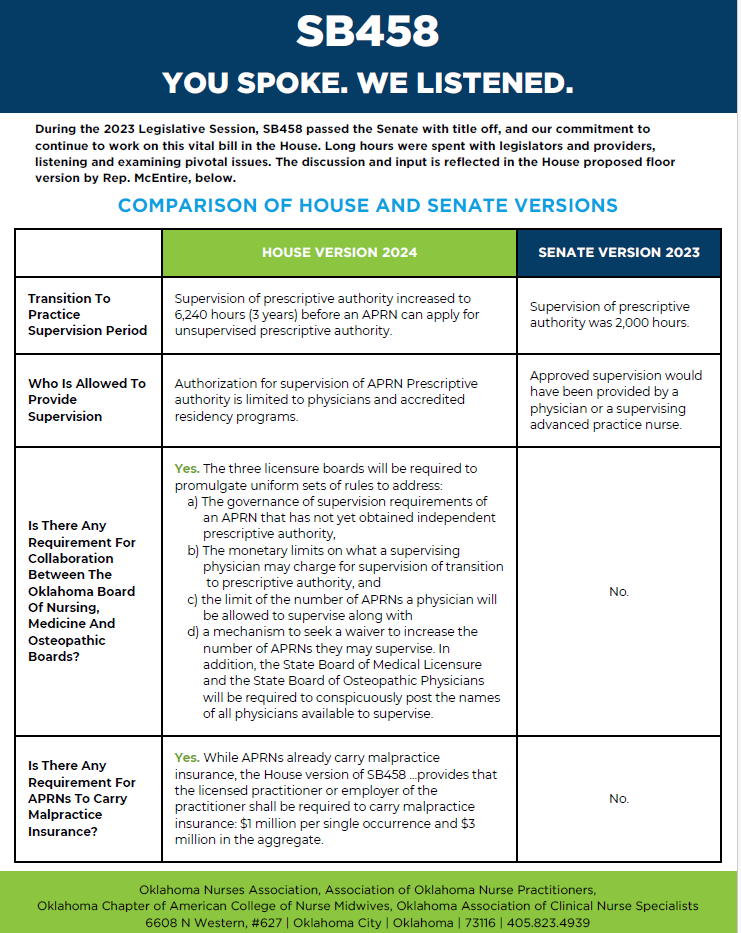
SB458 photo
Position Statement NACNS FPA
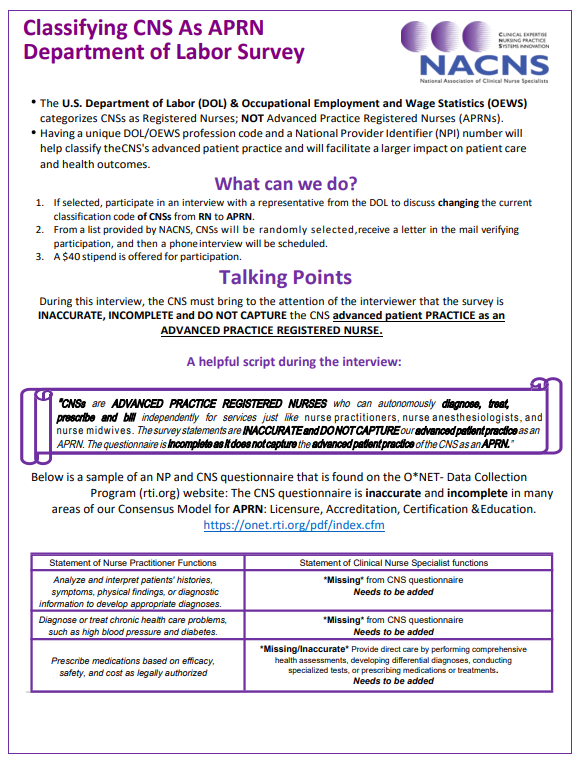
Department of Labor Survey

Requirements for APRNs Adding a New Specialty and National Certification

An Advanced Practice Registered Nurse (APRN) who wishes to add a new area of specialty and national certification must meet initial requirements for advanced practice licensure, as identified in the Oklahoma Board of Nursing Rules: 485:10-15-4(a). If you are currently a licensed Advanced Practice Registered Nurse and you want to add a new area of specialty, you will access or create an individual account through the Nurse Portal https://okbn.boardsofnursing.org/okbn. All licensure requests are submitted through the Nurse Portal. For additional information, you may review the application instructions located on the Oklahoma Board of Nursing website http://nursing.ok.gov/practice.pdf and the list of APRN Certification Examinations Approved by the Oklahoma Board of Nursing http://nursing.ok.gov/prac-natlcert.pdf to ensure your certification is listed. An APRN in accordance with the Oklahoma Nursing Practice Act, may prescribe medications that are within their scope of practice. The APRN must hold prescriptive authority recognition for each added advanced practice certification in order to prescribe medications and other medical supplies.

Renewal Reminders for APRNs Wanting to Renew Prescriptive Authority

The application for renewal of prescriptive authority is concurrent with the two-year (even years) RN and APRN licensure renewals. In preparing for prescriptive authority recognition renewal in 2020, please note the following reminders. During your 90-day renewal period, per the Oklahoma Nursing Practice Act and Rules, all Certified Nurse Practitioners (CNPs), Clinical Nurse Specialists (CNSs) and Certified Nurse Midwives (CNMs) must submit for all current supervising physicians, a new Agreement for Physician Supervising Advanced Practice Prescriptive Authority accessible at http://nursing.ok.gov/pa-1.pdf. The Agreement(s) for current physicians may be submitted in person, by mail, fax or as a scanned document to obnwebmaster@nursing.ok.gov. Changes in supervising physicians shall be filed with the Board within 30 days of the change. A Change in Supervising Physicians request form, accessible at http://nursing.ok.gov/pa-2.pdf), and fee must be submitted to the Board via mail or in-person along with the fee. Both Agreements (for supervising physicians) and Change Requests must be received in the Board Office prior to the expiration date of your APRN license and prescriptive authority recognition. The minimal education requirements for renewal of prescriptive authority are a minimum of 15 contact hours or one academic hour of education in pharmacotherapeutics, AND 2 hours of education in pain management, or opioid use or addiction for those APRNs who hold a federal Drug Enforcement Administration registration number